The transition to zero-energy buildings (ZEBs) has become central to climate mitigation strategies within the built environment. Historically, the buildings sector has been responsible for a substantial share of final energy use and greenhouse gas (GHG) emissions, driven by both operational energy (heating, cooling, lighting, ventilation) and the embodied carbon of construction materials and processes (Pérez-Lombard et al., 2008; UN Environment Programme & Global Alliance for Buildings and Construction [GlobalABC], 2024). This article synthesises key evidence and proposes an integrated, life-cycle oriented approach to achieve a net-zero carbon footprint in construction. It emphasises (1) rigorous reduction of operational energy demand, (2) decarbonisation of energy supply, and (3) rapid reductions in embodied carbon through material, design and policy interventions. The analysis draws on foundational studies of building energy consumption and recent, policy-relevant research on embodied carbon pathways (Pérez-Lombard et al., 2008; Watari et al., 2024; UN Environment Programme & GlobalABC, 2024).
Operational energy: minimising demand through design and systems
Reducing operational energy remains a cornerstone of ZEB strategies because even highly decarbonised grids cannot justify excessive energy waste (Pérez-Lombard et al., 2008). Early building energy research established that buildings in developed contexts often account for 20–40% of final energy consumption, highlighting the leverage of operational savings (Pérez-Lombard et al., 2008). Contemporary net-zero practice therefore prioritises passive design (orientation, envelope performance, thermal mass and shading), high-performance HVAC systems, airtightness and controls, and integrated design processes that align architectural and engineering objectives.
Operational reductions are most effective when pursued via iterative, model-based design and post-occupancy evaluation to close the performance gap between predicted and actual energy use. Strategies include right-sizing mechanical systems using dynamic simulation, commissioning and continuous commissioning, and occupant-centric controls that adapt to real usage patterns (Pérez-Lombard et al., 2008). Importantly, operational demand reduction reduces the scale of on-site or off-site renewable generation required to reach a net-zero balance, thereby improving economic feasibility (UNEP & GlobalABC, 2024).
Decarbonised energy supply: synchronising generation with reduced demand
Once operational demand is minimised, meeting residual energy needs with low-carbon supply becomes achievable. Decarbonisation pathways include on-site renewables (photovoltaics, solar thermal, ground-source heat pumps), procurement of renewable electricity, and electrification of building services combined with demand flexibility. Policy and finance mechanisms play a decisive role in accelerating adoption; the Global Status Report emphasises that current sectoral progress is insufficient and that coordinated policy signals and investment are required to align building stocks with Paris-compatible pathways (UNEP & GlobalABC, 2024).
A systems approach that valorises demand response, energy storage, and district energy systems can further reduce reliance on seasonal storage or high-emission fuels. Integrating building design with energy system planning at neighbourhood and city scales therefore amplifies the effectiveness of individual ZEB projects and mitigates rebound risks associated with isolated interventions (UNEP & GlobalABC, 2024).
Embodied carbon: the missing half of the balance
As operational energy declines in advanced low-energy buildings, embodied carbon — emissions associated with material extraction, manufacture, transport, construction, maintenance and end-of-life — becomes relatively more important (Watari et al., 2024). Recent peer-reviewed analysis demonstrates that achieving net-zero embodied carbon across building stocks is technically feasible by mid-century using available technologies and supply-side decarbonisation, combined with material substitution, optimized design and lifecycle extension (Watari et al., 2024).
Practical levers to reduce embodied carbon include:
• Material selection and substitution: increasing timber and other biogenic materials, where sustainable supply chains exist, can store carbon in structures and reduce emissions from concrete and steel production (Watari et al., 2024).
• Low-carbon material production: accelerating uptake of low-carbon cementitious binders and decarbonised steel through industrial policy and procurement.
• Design optimisation: structural efficiency, modular construction, and components standardisation reduce material intensity and waste.
• Circular economy measures: reuse, recycling and design for deconstruction extend material lifetimes and lower future embodied emissions.
• Life-extension and adaptive reuse: preserving and retrofitting existing stocks avoids emissions associated with demolition and replacement.
Watari et al. (2024) underscore that material-focused strategies — notably increased, responsibly managed timber use plus decarbonised upstream production — can deliver large embodied carbon reductions without waiting for speculative future technologies (Watari et al., 2024).
Integrating operational and embodied strategies: life-cycle carbon accounting
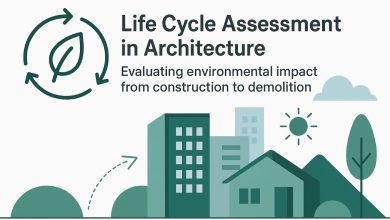
Net-zero goals require whole-life carbon accounting so decisions that reduce operational energy do not inadvertently increase life-cycle emissions (e.g., highly glazed facades with carbon-intensive frames) (Pérez-Lombard et al., 2008). Life-Cycle Assessment (LCA) provides a consistent framework to evaluate trade-offs across embodied, operational and end-of-life phases. Embedding LCA in early design stages enables comparison of material and system options, helps prioritise interventions with greatest net-life-cycle benefit, and supports transparent reporting.
Crucially, life-cycle accounting must adopt consistent system boundaries and temporal considerations (e.g., biogenic carbon storage, end-of-life emissions) to avoid double-counting or omission. Institutional guidance and standardisation, together with accessible databases, are therefore essential to scale the routine use of whole-life carbon metrics in procurement and regulation (UNEP & GlobalABC, 2024).
Policy, finance and procurement: enabling rapid sectorwide change
Technical measures alone are insufficient; systemic change depends on aligned policy, finance and market mechanisms. The Global Status Report documents a concerning lag in sectoral progress and calls for expanded policy ambition, targeted finance instruments, and public procurement that internalises whole-life carbon (UNEP & GlobalABC, 2024). Key enabling actions include mandatory life-cycle-based carbon limits for new buildings, incentives for low-carbon material markets, building-stock level renovation roadmaps, and training to scale low-carbon construction skills.
Procurement — particularly large public projects — can create demand for low-carbon materials and production methods, accelerating supply-side decarbonisation. Financial de-risking instruments and green loan frameworks that recognise life-cycle carbon savings will help mobilise capital for ZEB retrofits and low-carbon new builds (UNEP & GlobalABC, 2024).
Implementation challenges and research priorities
Important implementation barriers remain: variability in material data quality, regional constraints on low-carbon timber supply, the performance gap between predicted and actual building energy use, and the need for robust policy harmonisation across jurisdictions. Future research should prioritize improving embodied carbon inventories, evaluating regional supply-chain transformations, assessing social and ecological implications of scaled timber adoption, and developing integrated design tools that couple building physics with whole-life carbon outcomes (Watari et al., 2024; Pérez-Lombard et al., 2008).
Conclusion
Achieving net-zero carbon footprints in construction demands a dual focus on aggressive operational energy reduction and rapid embodiment decarbonisation, supported by life-cycle accounting, enabling policy, and market transformation. Foundational analyses of buildings’ energy use highlight the large opportunities for operational savings (Pérez-Lombard et al., 2008), while recent, empirically grounded research shows that net-zero embodied carbon is technically attainable through currently available measures when scaled with supply-side decarbonisation and sensible material strategies (Watari et al., 2024). The Buildings Global Status Report further emphasises that realising these technical potentials requires broader systemic shifts in finance, regulation and procurement to move the sector onto Paris-aligned pathways (UN Environment Programme & GlobalABC, 2024). In short, zero-energy buildings represent more than an architectural aspiration: they are an operational and material imperative that can and must be delivered through coordinated technological, economic and policy action.
References
- Pérez-Lombard, L., Ortiz, J., & Pout, C. (2008). A review on buildings energy consumption information. Energy and Buildings, 40(3), 394–398.
- UN Environment Programme & Global Alliance for Buildings and Construction. (2024). Global status report for buildings and construction. UN Environment Programme.
- Watari, T., Yamashita, N., & Cabrera Serrenho, A. (2024). Net-zero embodied carbon in buildings with today’s available technologies. Environmental Science & Technology, 58(4), 1793–1801.